We are celebrating our birthday
04.06.2025
Exhibitions come and go – but what happens to their materials when they are dismantled?
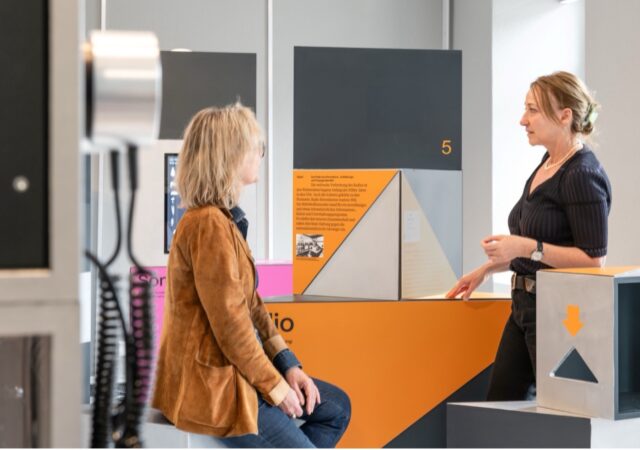
At the Lucerne Museum, an exhibition was not simply disposed of but creatively reshaped and reused. Tanja Warring, director of the museum, and Muriel Utinger, head of operations, talk to Happy Museums about how they created a new exhibition from existing elements, the challenges they had to overcome, and why sustainable museum technology means much more than recycling.
(Interview with Tanja Warring and Muriel Utinger, Lucerne Museum)
What does a sustainable exhibition mean to you?
Tanja Warring, Director of Lucerne Museum: A sustainable exhibition leaves a lasting impression on visitors. With "What Democracy Weighs?" we have created an exhibition that is integrated into the permanent exhibition and will be presented for a longer period. The construction system is also sustainable – it can be easily stored and reused.
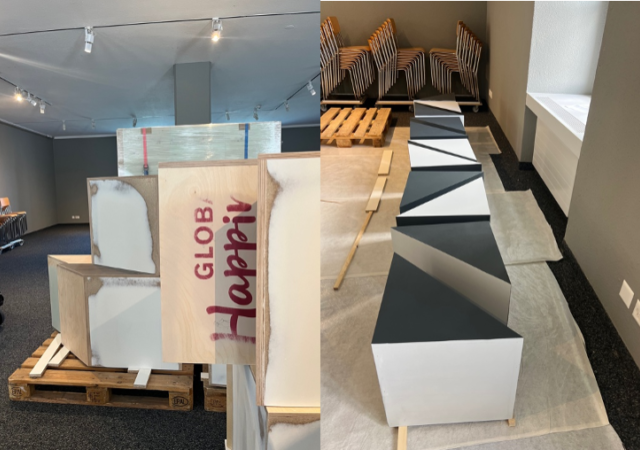
Muriel Utinger, Head of Operations: In museum technology, cheap MDF boards are often used. I would prefer to use solid wood, but it is a cost issue. Redesigning the "Global Happiness" exhibition was challenging because it was not designed for reuse. Thousands of screws, plugs, and cables had to be removed, and parts reassembled. To me, sustainability also means using locally sourced wood – for example, from a sawmill over 100 years old where foxes and other animals live.
Why an exhibition with reused materials?
Tanja Warring: I only joined when the decision had already been made. Initially, I hesitated, but it was exciting to see how we could transform the exhibition. It was ambitious, but the idea of creating a flexible, reusable system motivated us.
What motivates you, Muriel Utinger?
Muriel Utinger: Honestly, at first I thought this project would unravel on its own. But then a creative dynamic developed: We exchanged ideas, sketched, and found solutions together. It was really fun! Sustainability was a central motivation for me. A lot of material is wasted in museum technology. I've often had to dispose of valuable materials because there was no storage space. It makes sense to share resources, like shared storage spaces for exhibition materials. Personally, I've taken a lot with me – my entire animal stall is built from museum material! It pains me to throw away things that can still be used.
So you had a lot of creative freedom?
Muriel Utinger: Yes, we had to approach it openly. It wasn't about implementing a finished concept immediately, but finding a practical, sustainable solution together. And that was really enjoyable!
Were there external partners who were important?
Muriel Utinger: Yes, many – from the team to external carpenters. Such a project requires support at all levels.
And within the team?
Tanja Warring: The chemistry has to be right. We couldn't just write a concept and then implement it, but had to develop it in parallel. Luckily, our graphics office played along flexibly. We give the team freedom, which motivates them.
How does the aesthetic of reusing affect the exhibition content?
Tanja Warring: It's more about the approach than the aesthetic. I didn't know for a long time exactly what the exhibition would look like – that changed my curatorial approach. I now work more openly and allow myself to be surprised.
What about the technical implementation?
Muriel Utinger: When something is implemented manually, it has to be clean. At first, I had concerns about ignoring craftsmanship pride. We didn't want "just sustainable" without aesthetic claims.
How do you communicate the upcycling concept?
Tanja Warring: With texts and examples, like flower seeds from an old exhibition that visitors can take. We explain that they are expired but still usable – a symbol for our concept.
What happens after the exhibition?
Tanja Warring: It will remain in place for three to four years. After that, the elements will be stored if possible. Personally, I would like to design a new exhibition for children or young people.
And what happens to the remaining material?
Muriel Utinger: Most of the time, these are not stable constructions like in house building, but smaller elements that can be used for other purposes. Sometimes some of them can be reused in a future exhibition.
Is there anything you wouldn't do again?
Muriel Utinger: It's certainly difficult to take on a heavily scenographed exhibition. Taking apart and reusing the individual elements proves to be more resource-intensive. In the future, I would select materials more carefully and no longer take on entire exhibition concepts.
How could sustainable material use work better?
Tanja Warring: A shared warehouse for museums would be ideal, where exhibition materials could be shared. Individual museums often have too little space to keep everything. It would require central administration so that materials can be used efficiently.
Thank you very much for these special insights into the upcycling of an exhibition!
This interview was conducted as part of the project «Upcycling Global Happiness», funded by the Mercator Foundation.
Text vy: Laura Amstutz